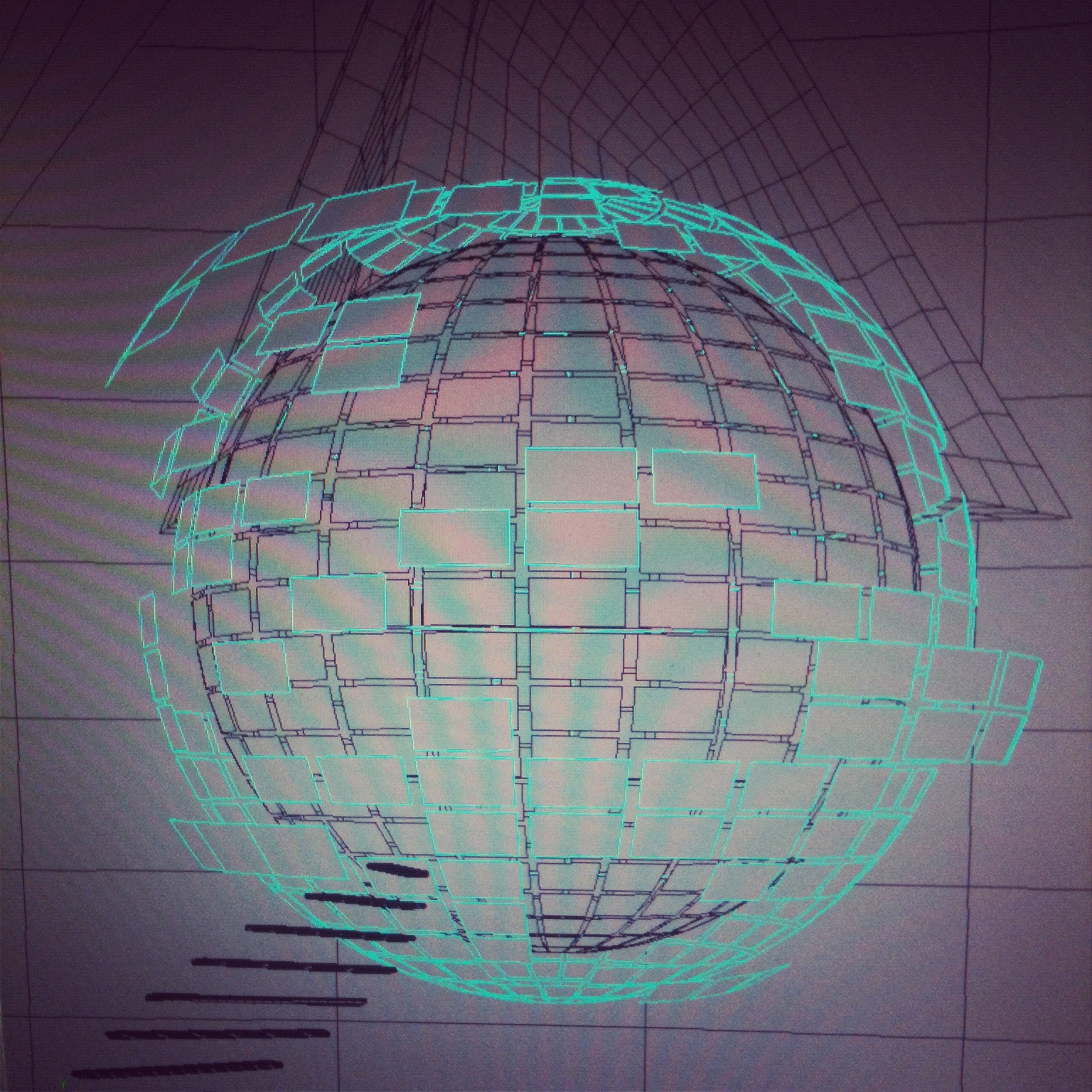
I'm working on the 3d geometry for the "virtual landscape" of my print project
and an ocean simulation because I'm interested to see how I can translate it through this process. I might add some text element and figures, especially since I'm required to use at least one line technique, I haven't really decided what I'll draw on the plate where I use those techniques. I'll be rendering out the 3d scene in passes, probably a combination of flat diffuse + ambient occlusion and another for the reflections, then they'll be printed onto transparency and exposed with a UV point light onto photosensitive film that has been applied to the surface of the copper plates. The multiple pass print process is very similar to modern compositing in the digital workflow; layers are added cumulatively, affecting the preceding state of the image, colour and transparency are modified to achieve the desired effect when overlaid. I'm amused by the idea of using a 3d application like Maya or Softimage to create render passes which I will use to produce physically existent plates and pass physically through a press with and onto real material, the same way I would digitally composite the layers in Photoshop or After Effects. There's something very funny and interesting about using modern technology to ultimately produce matrices to use in a final process that was the cutting edge technology in image generation 500 years ago, rescued from anachronism and obsolescence by the kind of innovations that make this possible and our continued interest in methodology, of course.


I'm still trying to figure out how to convey the idea of a users engaging in the process of creating the new "urban" or post-urban space, though I think the digital environment on its own is interesting enough to satisfy the requirements of the project.
"The history of city growth is, in essence, man's eager search for ease
of human interaction. Our large modern urban nodes are, in their very
nature, massive communications systems."
-Webber, M. 1964.
Urban Place and the Non-Place Urban Realm.
"Invisible spaces now dominate, as the city of the modernist era is replaced by the non-place urban realm and outer space is superseded by cyberspace." - Bukatman, S. 1993.
Terminal Identity: The Virtual Subject in Postmodern Science Fiction.
.JPG)
.JPG) Ryoji Ikeda's massive installations spanning the two DHC ART sites are an opus on the analysis, representation and interpretation of data. The primary medium used by Ikeda in this series is light; one part video projection and one part illumination of plastic and filmstrip transparency. Several of the datasets represented consist of cosmic maps and information relating to the sequence of DNA, I did not recognise the majority though; their contents are not made explicit and so the data exists without context, as an abstraction removed from the phenomena which it was created to describe. Ikeda is also a composer of music, a clicking, pulsing electronic score accompanies the video projection of the data, which runs about 8 minutes. Through the context of the gallery and the "curation" of the data and re-presentation as a film clip, Ikeda disembodies the raw data and projects it into the realm of aesthetics, where it becomes form and experience, information itself interpreted as art.
Ryoji Ikeda's massive installations spanning the two DHC ART sites are an opus on the analysis, representation and interpretation of data. The primary medium used by Ikeda in this series is light; one part video projection and one part illumination of plastic and filmstrip transparency. Several of the datasets represented consist of cosmic maps and information relating to the sequence of DNA, I did not recognise the majority though; their contents are not made explicit and so the data exists without context, as an abstraction removed from the phenomena which it was created to describe. Ikeda is also a composer of music, a clicking, pulsing electronic score accompanies the video projection of the data, which runs about 8 minutes. Through the context of the gallery and the "curation" of the data and re-presentation as a film clip, Ikeda disembodies the raw data and projects it into the realm of aesthetics, where it becomes form and experience, information itself interpreted as art. 
.JPG)
.JPG)
.JPG)
.JPG)
.JPG)


.JPG)

.JPG)
.JPG)


.JPG)
.JPG)
.JPG)
.JPG)
.JPG)
.JPG)




.JPG)
.JPG)