Gala
Showing posts with label info file. Show all posts
Thursday, October 11, 2012
Dominique Pétrin Palazzo II
Palazzo II is the exterior counterpart to Pétrin's "Gala" in situ treatment of the ARPRIM space, a visually arresting silkscreen makeover of existing surfaces.
Thursday, March 22, 2012
Urban Tribes, Subcultures and Neo-Tribalism
As early as 1950, sociologist David Riesman distinguished between a majority, "which passively accepted commercially provided styles and meanings, and a 'subculture' which actively sought a minority style ... and interpreted it in accordance with subversive values.
In considering the "wearer" for my designs placed in the concept of the speculative metacity, my project has turned toward urban tribes and subcultures. Examples of urban tribes are the punk movement that has persisted since the 70s, art collectives, various music and clubbing scenes, gangs, essentially even religious groups. When I design, I always feel like I'm picturing a certain group that may or may not yet exist, and depicting them and how they look. A defining principle of an urban tribe is that they seek forms of expression which are not ubiquitous within the dominant culture, visual self representation/differentiation (fashion) is very important in establishing group or individual identity, especially for those who intend to position themselves in a sense outside the broader society. Aesthetic codes and identity symbols are fundamental to fashion, self expression and human society itself.
These kinds of groups are inextricably linked to fashion and other creative communities; punk continues to be the most obvious "tribal" example but however countercultural, the community nature of music-based and other subcultures facilitates an inspiration/contributory relationship with fashion, art and other forms of expression.
In all ape species there is a tribal number, a manageable limit of organization and interaction; within civilisations we necessarily form groups of hopefully like-minded people. Sociologists have described 4 or 5 "groups of organization" that form within society, in “In Search of How Societies Work - Tribes: The First and Forever Form”, a 2006 paper by David Ronfeldt, these are described as tribes, hierarchical institutions, markets and networks. In the present, the Information Age, I feel that the term "networks" has taken on a different meaning, potentially global but potentially small communities: digital tribes.
Neo-Tribalism is a modern sociological phenomenon that has developed in response to civilization, or the modern corporation/state society, wherein smaller social groupings of like-minded or themed communities are formed. The most casual form of Neo-Tribalism is the urban tribe, a term first coined in 1985 by French sociologist Michel Maffesoli in Le temps des tribus: le déclin de l'individualisme dans les sociétés postmodernes. According to Maffesoli, urban tribes are microgroups of people who share common interests in metropolitan areas. The members of these relatively small groups tend to have similar worldviews, dress styles and behavioral patterns. Their social interactions are largely informal and emotionally-laden, which stands in sharp contrast to the formalized Machiavellian constructs of corporate culture. The term was expanded upon by author Ethan Watters in Urban Tribes: A Generation Redefines Friendship, Family, and Commitment as “an intricate community of young people who live and work together in various combinations, form regular rituals, and provide the support of an extended family.”
In considering the "wearer" for my designs placed in the concept of the speculative metacity, my project has turned toward urban tribes and subcultures. Examples of urban tribes are the punk movement that has persisted since the 70s, art collectives, various music and clubbing scenes, gangs, essentially even religious groups. When I design, I always feel like I'm picturing a certain group that may or may not yet exist, and depicting them and how they look. A defining principle of an urban tribe is that they seek forms of expression which are not ubiquitous within the dominant culture, visual self representation/differentiation (fashion) is very important in establishing group or individual identity, especially for those who intend to position themselves in a sense outside the broader society. Aesthetic codes and identity symbols are fundamental to fashion, self expression and human society itself.
These kinds of groups are inextricably linked to fashion and other creative communities; punk continues to be the most obvious "tribal" example but however countercultural, the community nature of music-based and other subcultures facilitates an inspiration/contributory relationship with fashion, art and other forms of expression.
Punks in the 70s/80s
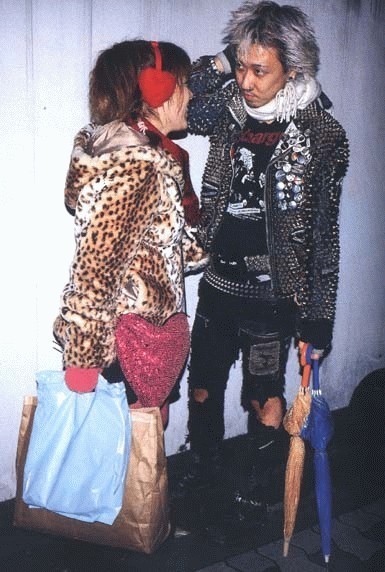
Kawakami from d-beat band Disclose and friend (early 2000s), d-beat is a very specific genre of music yet an entire subculture has formed around it, most popular in Japan and Scandinavia but known around the world
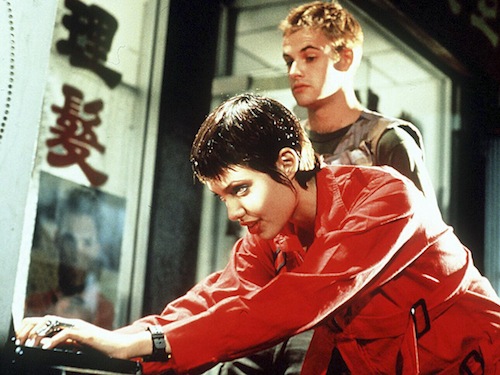
Angelina Jolie and Johnny Lee Miller in Hackers (1995), depictions of urban tribes in fiction have the potential to inform their real life equivalents
Bosozoku, a kind of motorbike/vehicle subculture, commonly dressed in long overcoats covered with painted slogans, wearing boots, baggy jumpsuits, surgical masks and badges.
In all ape species there is a tribal number, a manageable limit of organization and interaction; within civilisations we necessarily form groups of hopefully like-minded people. Sociologists have described 4 or 5 "groups of organization" that form within society, in “In Search of How Societies Work - Tribes: The First and Forever Form”, a 2006 paper by David Ronfeldt, these are described as tribes, hierarchical institutions, markets and networks. In the present, the Information Age, I feel that the term "networks" has taken on a different meaning, potentially global but potentially small communities: digital tribes.
Neo-Tribalism is a modern sociological phenomenon that has developed in response to civilization, or the modern corporation/state society, wherein smaller social groupings of like-minded or themed communities are formed. The most casual form of Neo-Tribalism is the urban tribe, a term first coined in 1985 by French sociologist Michel Maffesoli in Le temps des tribus: le déclin de l'individualisme dans les sociétés postmodernes. According to Maffesoli, urban tribes are microgroups of people who share common interests in metropolitan areas. The members of these relatively small groups tend to have similar worldviews, dress styles and behavioral patterns. Their social interactions are largely informal and emotionally-laden, which stands in sharp contrast to the formalized Machiavellian constructs of corporate culture. The term was expanded upon by author Ethan Watters in Urban Tribes: A Generation Redefines Friendship, Family, and Commitment as “an intricate community of young people who live and work together in various combinations, form regular rituals, and provide the support of an extended family.”
Wednesday, March 21, 2012
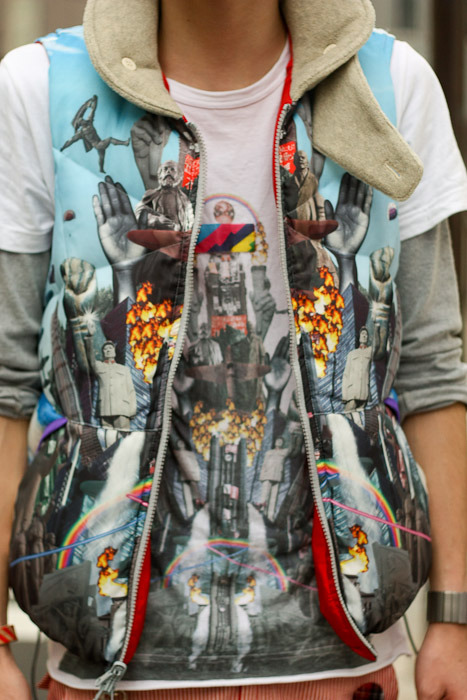
Having a hard time deciding if I love or hate the current state of digital print, it's so easy and relatively affordable to put any imagine on fabric now it seems like cheating and the quality of the prints can be so low res and badly compressed JPEG looking but...
this Manish Arora stuff looks so great to me, some people can use the technology so well. In the future we'll probably just wear screens that display constantly shifting, perfect resolution images of whatever we like on them and be walking screensavers.
Wednesday, March 14, 2012
Work In Progress: Sketchbook
I haven't had Internet access at home for almost a week so I haven't been able to update this blog! Anyway I've been putting my sketchbook together, working on designs, trying to sort out some screenprinting.
The recommended sketchbook process for students in the CSM Foundation Fashion Design program begins with gathering lots of printed research and in the first few pages of the sketchbook, assembling a collage to immediately convey the general feel or mood of the project through references images, inspiration and some drawing and annotation. It should be visually appealing and give the viewer a clear idea of where design ideas for the project are being drawn from.
From an early point in this project I want to convey moving beyond the physical city metropolis toward a more cyberpunk representation of the meta-city concept, which I tried to encompass with these circuitry-like glowing prints made from drawings of city structures: the "actual" city and the underlying metaphysical "cyberspace" of the city. This is the basic concept I'm attempting to design around; "the future is now", here are garments for those navigating the (de facto cyberpunk) metacity.
"Lines of light ranged in the nonspace of the mind, clusters and constellations of data. Like city lights, receding...Symbols, figures, faces, a blurred, fragmented mandala of visual information."
"Expanding - and flowed, flowered for him, fluid neon origami trick, the unfolding of his distanceless home, his country, transparent 3d chessboard extending to infinity. Inner eye opening to the stepped scarlet pyramid of the Eastern Seaboard Fission Authority burning beyond the green cube of the Mitsubishi Bank of America, and high and very far away he saw the spiral arms of military systems, forever beyond his reach."
-William Gibson, Neuromancer (1984)
After laying out the initial tone of the project in the first few pages, I'm incorporating more of my own work that responds to the research and inspiration and then getting into actual garment ideas. As the focus moves toward figure and fashion design drawing, print and details are explored, as well as fabric samples and photographs of draping/garment experiments that inform further designs.
Saturday, March 3, 2012
CityLIFE and Metabolist Movement
"After reading Project Japan: Metabolism Talks, a book by Rem Koolhaas about the 60’s – 70’s avant-garde architectural group titled “Metabolism”, Jean-Marc Emy decided that his proposal for the CityLIFE challenge will be a tribute to the Metabolists works."
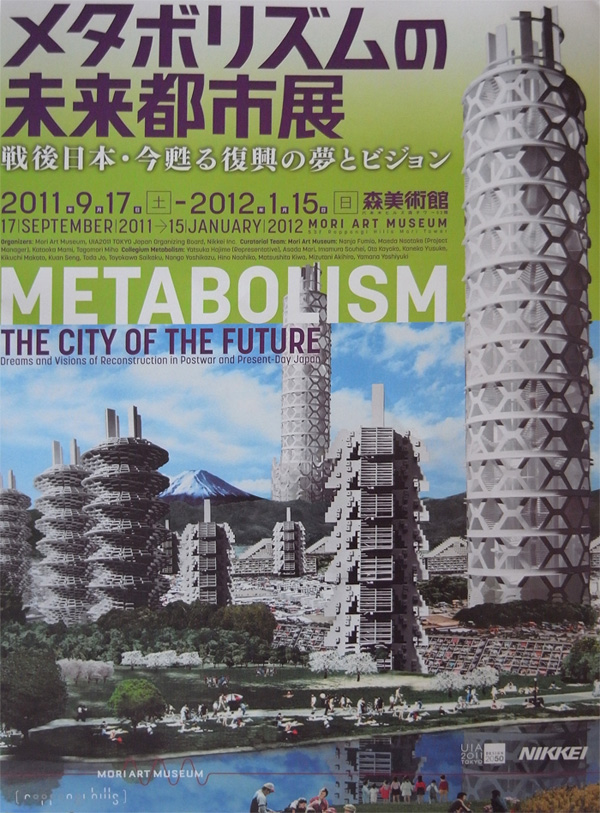
After checking out this entry I did some research on the Metabolist architectural movement: Their visions for cities of the future inhabited by a mass society were characterized by large scale, flexible, and expandable structures that evoked the processes of organic growth. In their view, the traditional laws of fixed form and function were obsolete. Metabolism arose in post-World War II Japan, and so much of the work produced by the movement is primarily concerned with housing issues.
"The young Japanese architects who launched themselves with the manifesto ‘Metabolism 1960’ at the World Design Conference in Tokyo that year had all been teenagers in 1945, when the cities of Hiroshima and Nagasaki were wiped out by atomic bombs. Devastatingly aware of the impermanence of built spaces and the destructibility of cities, they responded to the widespread housing crisis of postwar Japan by calling for more flexible and dynamic urban models. Promising to design spaces for living bodies that would be more in line with the metabolic processes of those bodies, they conceived of cities as living, moving and evolving creatures." -source
Kenji Ekuan, Dwelling City, 1964
This kind of city-thinking seems applicable now more than ever, I definitely want to do some drawings based on the Metabolist movement and explore them as part of the city my project is based around.
Roberto Piqueras aw 2012
I woke up an hour before this show and saw it mentioned on tumblr and noticed a friend had invited me on Facebook. This is how we communicate now I guess. I made my way over, it was close by, the "runway" a path outside some flats just off Bethnal Green Road. Roberto Piqueras has come from Barcelona to London to do this collection, I think he won a grant and, among other things, was recently sponsored by Burger King (I see french fries in lots of these prints haha). Some of the shoes were Jeffrey Campbell platforms in neon and bearing his prints. The show was quite intimate; a few members of the Spanish press, local photographers and a crowd of no more than 30 witnessing his print-focused presentation.
Dystopic images of the Queen and other Anglonalia, colors and forms belonging to the digital realm and some photo based prints, Piqueras' collection looked very "London". This is the kind of thing that will find an eager market on the internet if not in the small, clandestine boutiques around town.
My favorite print motif, a large scale photographic print of some burning candles in front of a branch with the Japanese phrase 私は信じたい (I want to believe). Believe what, I don't know, but it looked nice and wearable.
Guests received a sheet of temporary tattoos like the ones used in the styling of the models. Cute and zeitgeisty as heck.
Friday, March 2, 2012
Yayoi Kusama @ Victoria Miro
Victoria Miro gallery is currently showing some of Yayoi Kusama's most recent work, I really liked the organic form sculptures that look like they could be either extraterrestrial or microscopic amoeba things. I was reminded of the flora and fauna from the alien worlds of Masaaki Yuasa's Kaiba:
Kusama, Y. (2012) Yayoi Kusama New Works. London: Victoria Miro Gallery
Kaiba (2008) Directed by Masaaki Yuasa
Tuesday, February 28, 2012
Monday, February 27, 2012
Cybernetic Organism
"The cyborg would not recognize the Garden of Eden; it is not made of mud and cannot dream of returning to dust."
A cyborg is a cybernetic organism, a hybrid of machine and organism, a creature of social reality as well as a creature of fiction. Social reality is lived social relations, our most important political construction, a world-changing fiction. By the late twentieth century, our time, a mythic time, we are all chimeras, theorized and fabricated hybrids of machine and organism; in short, we are cyborgs. The cyborg is our ontology; it gives us our politics. The cyborg is a condensed image of both imagination and material reality, the two joined centres structuring any possibility of historical transformation. -Donna Haraway's A Cyborg Manifesto
Mariko Mori, "Subway" 1994
Givenchy fw 1999
Ghost in the Shell (1995) Directed by Mamoru Oshii, based on work by Masamune Shirow
Donna Haraway, "A Cyborg Manifesto: Science, Technology, and Socialist-Feminism in the Late Twentieth Century," in Simians, Cyborgs and Women: The Reinvention of Nature (New York; Routledge, 1991), pp.149-181.
Sunday, February 26, 2012
Undercover "SCAB" (s/s 2003)
Heavily deconstructed, patched up DIY. Undercover's Paris debut was largely made up of pieces that look like you could make them at home but the attention to detail is Jun's saving grace, what appeals to me most about this collection is the departure from crust punk to a different sort of urban tribe with its own implied idiosyncrasies and semiotics: the enigmatic logos and symbols, the combination of industrial and dark with very bright, colorful "folk" embroidering and patterns.
Subscribe to:
Posts (Atom)


.jpg)
.jpg)
.jpg)